Where your pool budget actually goes
Pool costs add up fast, but not always where owners expect. If you already own a pool, this guide shows the main budget buckets, the usual US price ranges, and how to spend smarter without cutting corners on safety.
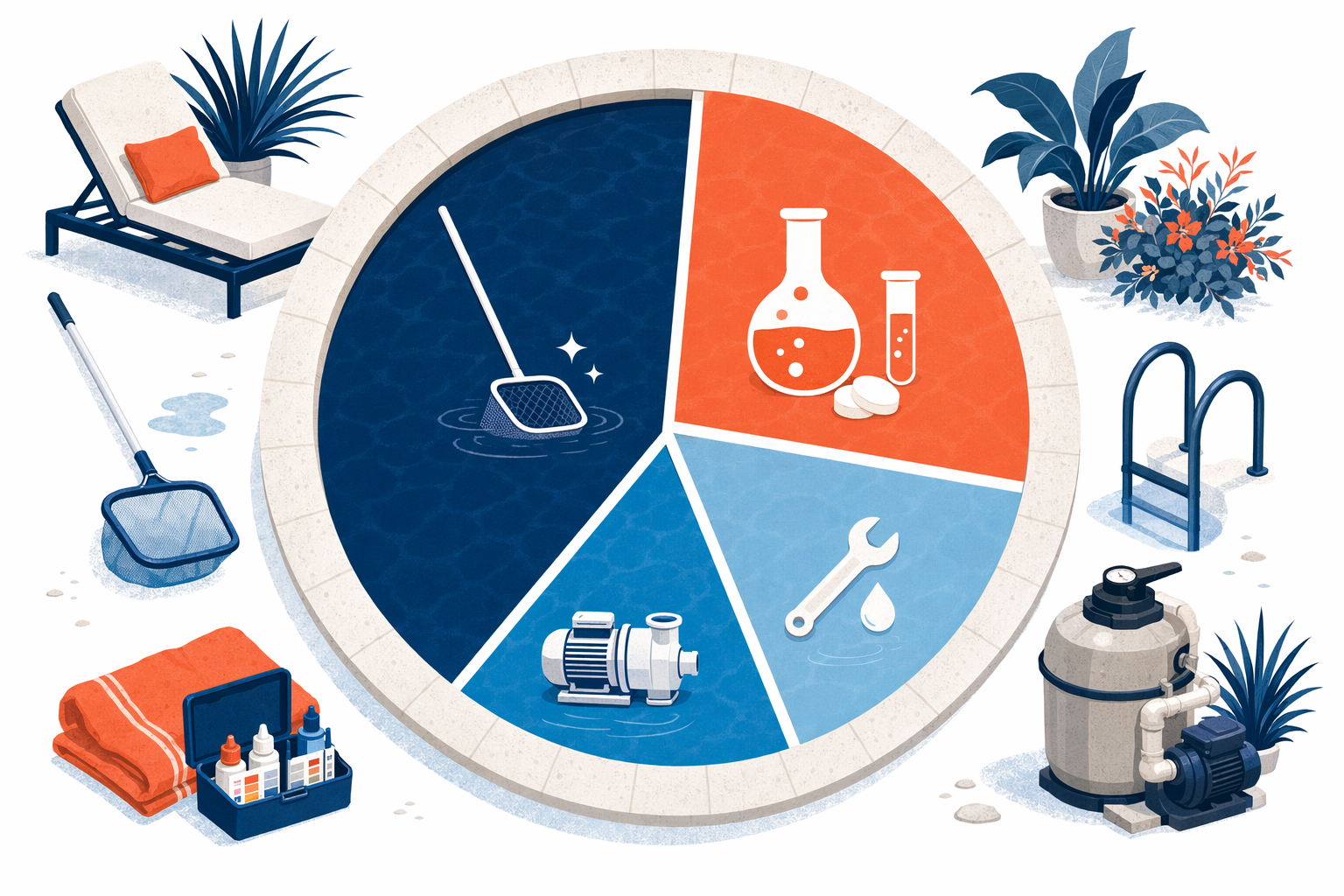
The big picture: most pool money goes to upkeep, not surprises
Owning a pool is usually not about one giant bill every month. It is a mix of regular care, occasional repairs, and larger age-related work that shows up every few years.
For many owners, the most predictable cost is routine service. Typical weekly maintenance runs about $30-$90 per visit or $100-$350 per month, depending on your pool size, how often it needs service, what is included, and your local labor rates. That may cover skimming, vacuuming, brushing, emptying baskets, basic water testing, and small chemical adjustments. Some plans include more. Some charge extra for filter cleaning, salt cell care, or heavy algae cleanup.
Then there are the costs people forget to budget for:
- Equipment wear like pumps, heaters, filters, timers, and automation parts
- Water chemistry corrections after storms, heat, heavy use, or neglected care
- Leak detection and repair when water loss is more than normal evaporation
- Seasonal opening and closing in colder parts of the US, often $200-$500 each
- Surface and renovation work when plaster, tile, coping, or decking starts to fail
A clean-looking pool can still hide expensive issues. A struggling pump, a small suction-side air leak, scale buildup, or poor water balance can shorten equipment life and lead to much bigger bills later. That is why cheap service is not always cheap in the end.
If you want a quick overview of common service categories, start with pool services.
Budget bucket #1: routine maintenance and water chemistry
Routine care is where many owners try to save money first. Sometimes that works. Sometimes it creates the exact repair bill they were trying to avoid.
Weekly or biweekly service usually pays for labor, travel, basic testing, and normal cleaning tasks. In many areas, $100-$350 per month is a realistic range for standard recurring care. A very simple pool in a low-cost area may land lower. A larger pool, spa combo, heavy debris load, or more demanding service plan may run higher.
What drives that price?
- Pool size and shape: More water, more brushing, more vacuuming, more chemicals.
- Tree cover and debris: Leaves and pollen mean more labor and more filter load.
- Screened vs. open pool: Open pools often need more cleanup.
- Pool type: Saltwater, plaster, pebble, vinyl, and fiberglass all have different care patterns.
- What is included: Chemicals may be included, partly included, or billed separately.
Chemistry is a budget line people underestimate. A pool can look blue and still be unbalanced. Bad chemistry can damage plaster, metal parts, heaters, and salt cells. It can also lead to cloudy water, scaling, staining, and algae treatment costs.
If you do some care yourself, learn the basics first. Simple testing and basket cleaning can help you spot trouble early. But chemicals are not something to guess at. Never mix pool chemicals, store them safely, follow the label, and keep them away from children and pets. When water is badly out of balance, a licensed and insured pool pro often handles dosing more safely. For a simple primer, see pool water chemistry basics.
Budget bucket #2: equipment repairs and replacements
Equipment is where a lot of the money goes after routine care. Pools have moving parts, electrical components, seals, controls, and heaters working in sun, rain, heat, and chemical exposure.
Some honest typical ranges:
- Pool pump replacement: about $700-$2,500 installed
- Heater repair: about $150-$700
- Heater replacement: about $2,000-$5,000+
- Leak detection: about $300-$600
Real price depends on your pool's size and condition, the equipment brand and model, the scope of work, and your area.
Why do repair costs swing so much?
- A simple seal, capacitor, sensor, or control issue is very different from replacing the full unit.
- Access matters. Tight equipment pads and older plumbing can raise labor time.
- Matching older systems can be harder than installing current standard parts.
- Some failures come with related work. A bad pump may expose valve, plumbing, or electrical issues nearby.
A common mistake is replacing equipment too late. Owners sometimes ignore weak circulation, noisy bearings, short cycling, slow heating, or a rising electric bill. Those warning signs usually mean the system is working harder than it should.
Another mistake is replacing the wrong thing first. A good pro should diagnose before swapping expensive parts. If you want help understanding what the equipment actually does, read pool equipment explained. If you need help finding someone to inspect a problem, you can get matched with licensed and insured local pros at no cost.
Budget bucket #3: the big-ticket items owners forget about
The most painful pool bills are often the ones that do not happen every month.
Leaks are a good example. Water level drops in hot weather, so many owners wait too long. But a leak can waste water, damage soil under decking, stress equipment, and cause chemistry swings. Typical leak detection runs $300-$600, and repair costs vary widely depending on where the leak is and how easy it is to reach.
Resurfacing and renovation are another major budget bucket. If your plaster is rough, stained, etching, flaking, or wearing through, you may be getting close. Typical resurfacing or replastering often falls around $5,000-$20,000+ depending on pool size, finish type, prep work, and your market. Tile, coping, lights, and other updates can raise that total.
Seasonal service matters in colder climates. Openings and closings are often $200-$500 each. Skipping a proper closing can lead to freeze damage, cracked lines, broken fittings, or ugly spring cleanup bills.
Watch for these signs that a larger expense may be coming:
- Water loss beyond normal evaporation
- Cracks, hollow spots, rough plaster, or recurring stains
- Equipment older than expected and needing repeated small repairs
- Slow heating or heaters locking out often
- Rising utility use without a clear reason
Larger work is where owners really need to compare scope, not just price. One estimate may include prep, startup chemicals, and cleanup. Another may not. For more on major surface work, see resurfacing and renovation.
How to spend smarter without buying the cheapest option
Trying to save money is normal. The trick is to save in the right places.
Here is a practical approach:
- Separate recurring care from one-time fixes. Ask what a monthly plan includes and what costs extra.
- Get 2-3 written estimates for bigger work. Compare the exact scope, parts, labor, cleanup, and warranty terms.
- Ask what happens if they find more problems. Hidden issues are common in older pools.
- Verify license and insurance yourself. Do not just take a truck wrap or website claim as proof.
- Ask for model numbers on major equipment. That makes comparisons easier.
- Do not pay a large deposit without a clear written scope and price. You compare quotes, you choose who to hire, and you hold the final payment until agreed work is done.
The cheapest monthly service can cost more later if visits are rushed, chemistry is inconsistent, or small issues are ignored. On the other hand, the highest price is not always the best value either. You want a licensed and insured pro who explains the work clearly, shows up consistently, and puts the scope in writing.
Before hiring anyone, use this checklist: how to vet a pool service company.
Common mistakes that blow up a pool budget
Owners usually get burned in the same few ways.
- Waiting too long to investigate water loss. A small leak can become a deck, plumbing, or shell problem.
- Ignoring chemistry because the pool "looks fine." Surface damage and equipment wear can start long before the water looks bad.
- Skipping routine cleaning. Debris, clogged baskets, dirty filters, and algae recovery cost more than prevention.
- Accepting a vague estimate. If the scope is not specific, extra charges show up later.
- Hiring without checking license and insurance. Always verify both yourself.
- Paying based only on friendliness or speed. Fast scheduling is nice. Competence matters more.
- Cutting corners on safety items. Fences, self-closing gates, alarms, covers, and supervision are not optional "extras" when children may be nearby.
Pool safety deserves its own budget line. Drowning is fast and silent. Never leave a child unattended near water. Use layers of protection: barriers, alarms, covers where appropriate, and active adult supervision. Follow local safety and building codes for your area. For a simple refresher, read pool safety basics.
If you are not sure what your own pool may cost this year, start with typical ranges at pool costs, then request matches and compare written estimates.
Most pool money goes to regular cleaning and chemistry, then equipment repairs, leaks, seasonal service, and surface work as the pool ages. Compare written estimates, verify license and insurance yourself, do not ignore small problems, and keep safety and water balance from slipping.