Pump, filter & heater repair
When pool equipment starts acting up, the pool can turn cloudy, unsafe, or expensive to run fast. PoolSteward helps you compare licensed, insured pool repair pros for **existing pools** at no cost, so you can choose the right fix with clear pricing in writing.
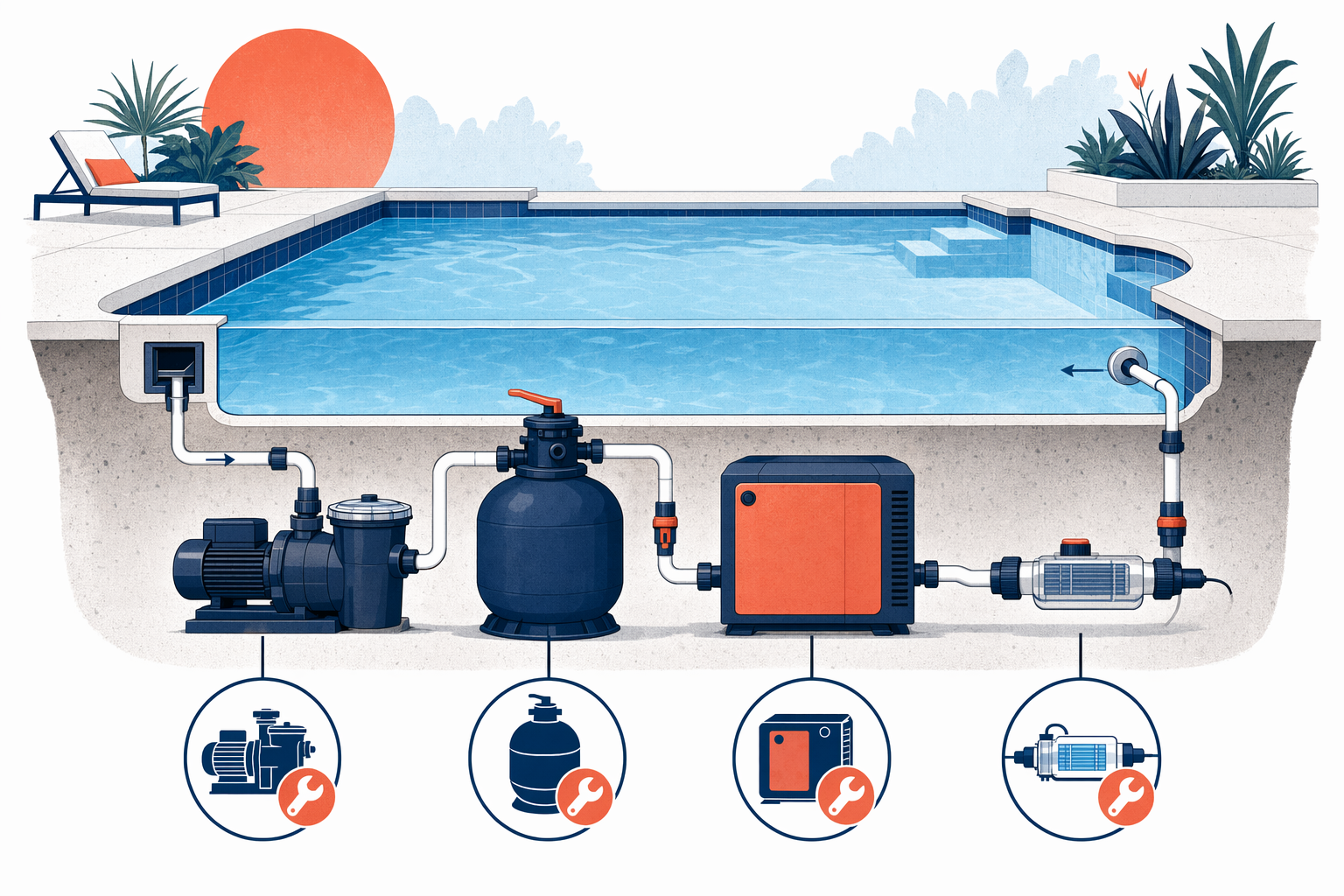
What this service covers
Pool equipment repair usually means fixing or replacing the parts that keep water moving, clean, and warm. On most backyard pools, that means the pump, filter, and heater.
A pool pro may be called for problems like:
- Pump not turning on, humming, leaking, or losing prime
- Weak water flow at returns or suction problems at the skimmer
- Filter pressure too high or too low
- Sand, DE, or cartridge filter leaking, clogging, or not cleaning well
- Heater not igniting, showing error codes, short-cycling, or not reaching temperature
- Loud motors, burning smells, tripped breakers, or obvious rust and corrosion
Sometimes the fix is small. A bad seal, clogged impeller, dirty filter, pressure gauge, ignition part, or sensor may be the issue. Sometimes replacement makes more sense, especially if the motor is failing, the heater core is badly corroded, or the tank or housing is cracked.
If you are not sure whether you need repair or replacement, a licensed, insured pool pro can inspect the system and explain the options. For a broader look at related problems, see equipment repair and pool equipment explained.
Common signs your pump, filter, or heater needs attention
Do not wait too long. Small equipment problems often turn into bigger water-quality problems or higher power bills.
Watch for these signs:
- The pump gets loud. Grinding, screeching, rattling, or a hot motor can mean bearings, seals, or the motor itself are failing.
- The pool stays cloudy. If chemistry is close but water still looks dull or dirty, circulation or filtration may be the real issue.
- Pressure changes suddenly. A filter pressure reading that jumps or drops can point to blockage, a dirty filter, air leaks, or internal damage.
- The heater runs but does not heat. That can mean scale, ignition trouble, sensor failure, low flow, or a larger internal problem.
- You see water where it should not be. Drips under the pump, around unions, at the filter clamp, or near the heater should be checked.
- The breaker trips. Electrical issues are a safety concern. Turn the equipment off and have a licensed, insured pro inspect it.
For water issues caused by circulation and filtration problems, it also helps to understand the basics of pool water chemistry.
How the repair process usually works
A straightforward repair call often follows the same basic path:
- You describe the problem. Share what equipment you have, what it is doing, when the problem started, and any error codes, leaks, noises, or photos.
- A pro inspects the system. They check flow, pressure, power, connections, visible leaks, and the condition and age of the equipment.
- You get options. Good pros explain whether a repair is reasonable, what parts are needed, and when replacement may be the better long-term value.
- You get the price and scope in writing. That should list labor, parts, any trip or diagnostic fees, and what is not included.
- Repair or replacement is scheduled. Some jobs are same day if the part is on the truck. Others wait on parts or a full equipment swap.
- The system is tested. The pro should confirm circulation, pressure, heating, and normal operation before wrapping up.
PoolSteward does not repair equipment or diagnose your system. We help you use free matching to compare local licensed, insured pool pros. You compare the options, ask questions, and choose who to hire.
Typical cost ranges
These are typical ranges and estimates, not quotes or guarantees. The real price depends on your pool's size and condition, the equipment brand and age, the exact part that failed, the scope of work, and your area.
Common equipment costs:
- Pump repair: often $150-$800 depending on whether the issue is a seal, impeller, capacitor, wiring, or motor-related problem
- Pump replacement installed: often $700-$2,500
- Filter repair: often $150-$750 for valves, grids, cartridges, gauges, clamps, air leaks, or minor housing issues
- Filter replacement installed: often $800-$2,000+ depending on filter type and size
- Heater repair: often $150-$700
- Heater replacement installed: often $2,000-$5,000+
- Leak detection, if the issue may be plumbing or underground rather than equipment: often $300-$600
A few honest notes:
- A cheap repair is not always the best deal if the equipment is very old or other parts are near failure.
- A full replacement costs more upfront, but it may lower energy use and reduce repeat service calls.
- If multiple items are failing at once, ask for prices broken out by line item so you can compare repair-now versus replace-now choices.
You can read more about broader pool service pricing at pool service costs.
How long it takes
Timeline depends on the problem and whether parts are easy to get.
Typical timelines:
- Simple diagnosis: often 30-90 minutes on site
- Minor pump or filter repair: often same day to 2 days
- Heater repair with common parts: often 1-3 days
- Full pump replacement: often half a day to 1 day
- Full filter replacement: often half a day to 1 day
- Full heater replacement: often 1 day, sometimes longer if parts, venting, pad changes, or local requirements affect the job
Ask what could slow the job down. Common delays include backordered parts, old equipment that needs extra fittings, rusted connections, electrical issues, or discovering a leak outside the equipment pad.
If the pool will be partly drained or equipment will be offline, ask how to protect water quality until the work is done. A pool owner should never guess with chemicals. Store chemicals safely, never mix chemicals, follow label directions, and know that a qualified pro often doses more safely.
Repair vs. replace: how to think about it
There is no single rule, but these questions help.
Repair may make sense when:
- The equipment is fairly new
- The problem is limited to one part
- The housing or tank is still in good shape
- The repair cost is small compared with replacement
- The system has otherwise been reliable
Replacement may make more sense when:
- The unit is older and parts are failing one after another
- The motor, heat exchanger, tank, or major body is damaged
- Corrosion is heavy
- The repair is a large share of replacement cost
- The equipment has been oversized, undersized, or poorly matched to the pool
Pros of repairing:
- Lower upfront cost
- Faster if the part is available
- Less disruption to the pool area
Cons of repairing:
- Another part may fail soon on older equipment
- Warranties may be limited on older systems
- Efficiency may still be poor compared with newer equipment
Ask the pro one simple question: 'If this were your pool, would you repair it or replace it, and why?' A good answer should be specific, not pushy.
What to ask before you hire
This is where many pool owners save money and avoid trouble. Hire licensed and insured pool pros, and verify the license and insurance yourself. Get the final price and scope in writing before any deposit.
Use this checklist:
- Are you licensed for this work in my area, and can I verify it?
- Are you insured? Can you send proof?
- What exactly is causing the problem?
- Are you recommending repair, replacement, or both as options?
- What parts are included in the written price?
- Is there a diagnostic fee, trip fee, or return-visit fee?
- How long should this fix last in normal use?
- What warranty applies to labor and parts?
- Will any other trades or permits be needed in my area?
- What maintenance should I do after the repair?
Also ask for model numbers on replacement equipment so you can compare apples to apples.
If children use the pool, keep safety front and center during any repair period. Drowning is fast and silent. Never leave a child unattended near water. Use layers of protection like fences, self-closing gates, alarms, covers, and active supervision, and follow local safety and building codes. For more on screening companies and pool safety, see how to vet a pool service company and pool safety basics.
If your pump, filter, or heater is acting up, do not guess. Get a licensed, insured pool pro to inspect it, compare repair and replacement options, and make sure the price and scope are in writing before you pay a deposit. PoolSteward can help you get matched for free, and you stay in control of who you hire.